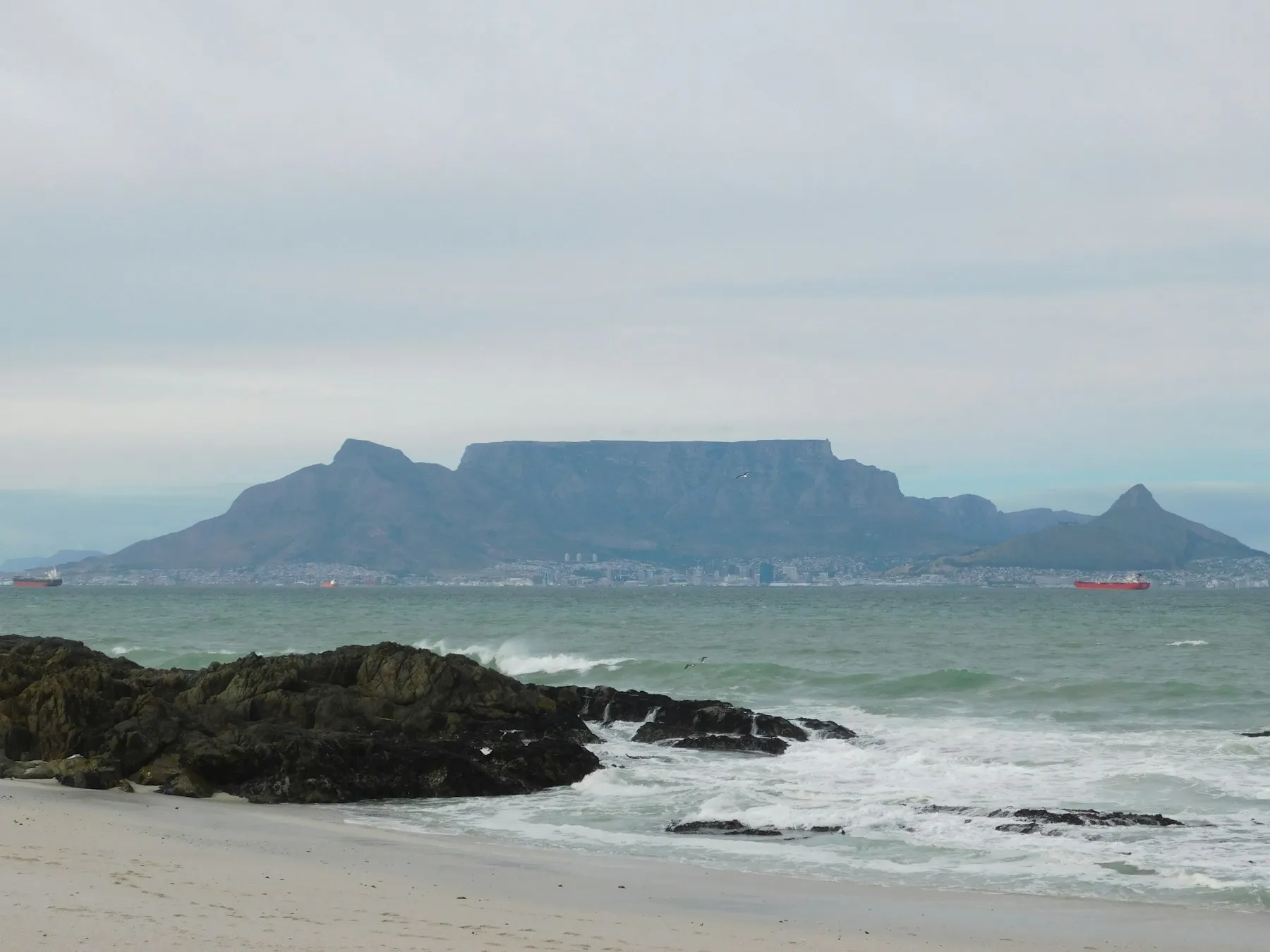
Table Mountain seen across Table Bay from Bloubergstrand

Waterproofing Blouberg

Waterproofing in Blouberg has to survive two seasons doing two different jobs. Summer sand abrades your walls and opens hairline cracks, then winter rain arrives sideways and finds every one of them. Free inspection, two-year written guarantee.

  • 18 years in trade
  • Two-year written guarantee
  • Free inspection

How It Works

  1. 1

    Free site inspection

    Roof, walls and the seaward elevation, since here the walls matter as much as the roof.

  2. 2

    Written quote before work starts

    Preparation costed separately from waterproofing.

  3. 3

    Work completed, system specified

    Wall coatings treated as a waterproofing item, not a decorating one.

  4. 4

    Guarantee and follow-up

    Two-year written guarantee, plus a check after the first winter.

Blouberg buildings are exposed on an open, flat coastline with nothing between them and the weather. That changes what fails, and it means the wall coatings here need as much attention as the roof does.

Summer Opens the Cracks, Winter Finds Them

This is the Blouberg mechanism, and it is a two-stage process that most people only ever notice the second half of.

Stage one, summer. The south-easter blows hard across an open, flat, sandy coastline from roughly November to April. It is a dry wind, so it puts no water into any building. What it carries is sand, and sand travelling at speed against a rendered or painted wall works exactly like fine abrasive paper.

Over seasons, that abrasion thins paint films and surface coatings, particularly on the exposed elevations and at corners and edges where the wind accelerates. Once the film is thin enough, it crazes. What you get is a network of hairline cracks in a wall surface that still looks broadly sound from a distance.

Stage two, winter. The north-wester arrives from May, off the open Atlantic, at 50 to 65kph. It drives rain horizontally straight into the same seaward walls that have spent the summer being sandblasted.

Horizontal rain at pressure does not need a big crack. Hairline crazing is enough, because the water is being pushed rather than falling. It enters the render, gets held against the masonry behind, and comes through as penetrating damp on the inside face.

The homeowner sees damp on an internal wall in July and looks for a leak. There is no leak. There is a wall coating that lost its integrity in December.

The practical consequence is that wall coatings here are a waterproofing item, not a decorating item, and they have a shorter life on the exposed elevations than the manufacturer general figure suggests.

Salt, Metal and Everything That Corrodes

Blouberg sits on an open beachfront, which means continuous salt deposition on every surface of every building.

Metal roofs are common here, and salt attacks them at every point where the protective coating is broken. Fixings and their washers go first, then cut edges, then laps. The sheeting itself is often still sound when the roof is leaking through a hundred fixing points.

Galvanic corrosion runs faster in salt air, so using a fixing that is not compatible with the sheeting means the screw corrodes while the sheet stays perfect.

Gutters, brackets and downpipes corrode at joints, bracket contact points and cut ends.

Balustrades, handrails, awnings and any exposed steel, all of which corrode at their fixings, and every fixing through a horizontal surface is a potential leak.

Concrete takes chloride the same way it does on the Atlantic Seaboard, so exposed slab edges, balcony soffits and parapets spall on older buildings.

Combine salt with the summer abrasion and the winter driving rain, and Blouberg is one of the harder environments in Cape Town to keep a building envelope intact.

Sand, Gutters and Flat Ground

A few things here are specific to the terrain rather than the sea.

Wind-blown sand fills gutters through summer, and unlike leaves it forms a dense silt that holds water against the metal permanently and does not blow out again. Gutters here need clearing before winter regardless of whether there are trees, which catches people out, because there often are not.

Sand gets into flat roof outlets and valleys, and a sanded-up outlet blocks completely rather than partially.

The ground is flat and sandy, which means surface water behaves differently to the slopes on the other side of the city. Drainage away from buildings matters, and downpipes discharging at the base of a wall saturate sandy ground that then holds water against the foundation.

Newer developments across Blouberg, Big Bay and Parklands bring their own pattern: contemporary flat and low-pitch roofs, parapets, large glazed elevations facing the sea and the view, and balconies over living space. All of that is more detail-dependent than a traditional pitched roof, in an environment that punishes detail failures fast.

Why Choose Us in Blouberg

  • We inspect before we quote

    Nobody prices a roof from a photograph or a phone call. We get on the roof or into the roof void, establish what is actually wrong, and quote from that.

  • Preparation is quoted separately

    Substrate repair, falls correction and strip-off appear as their own line items. That is the part that determines whether the work lasts, and the part most quotes hide.

  • We say when repair is the cheaper answer

    Plenty of roofs quoted for replacement need a day of repairs. We tell you which yours is, including when it means a smaller invoice for us.

  • Two-year written guarantee, in writing

    Minimum two years on our workmanship, with the scope set out on the quote before you sign. We check the work again after the first winter.

Waterproofing in Blouberg FAQs

How much does waterproofing cost in Blouberg?

It depends whether the problem is the roof, the wall coatings, or both, which here is common. We inspect the seaward elevations as well as the roof, and quote preparation separately from the waterproofing.

My internal wall is damp but I cannot find a leak. What is happening?

Very likely driven rain through a crazed wall coating on the seaward elevation. Summer sand abrasion thins the coating and opens hairline cracks, then winter fronts push water straight through them at pressure.

Does the summer wind really damage my walls?

Yes, and this is the part people miss. The south-easter carries sand across an open coastline and abrades exposed wall surfaces like fine sandpaper. It does no damage you would notice at the time, and it sets up the leak that appears in winter.

How often do wall coatings need redoing here?

Sooner than the general manufacturer figure, on the exposed elevations. Sheltered elevations last considerably longer. It is worth treating the seaward walls as a waterproofing item on their own maintenance cycle.

Why do my metal roof fixings keep corroding?

Salt air accelerates corrosion generally and galvanic corrosion specifically. Fixings and their washers are the shortest-lived component on the roof, and using a screw incompatible with the sheeting makes it much faster.

Do gutters need cleaning if I have no trees?

Yes. Wind-blown sand fills gutters here through the summer and forms a dense silt that holds water against the metal and does not blow out. It is a different problem to leaves and it catches people out.

My flat roof outlet blocked completely. Why?

Sand. Unlike leaf debris, which partially blocks, sand silts an outlet up solid. On flat roofs here that means water sitting on the roof through a whole winter front, which is when it comes over the upstands.

Should the seaward side of my house get a different specification?

It should get more attention, yes. Exposure is not even across a building here, and the north-west and seaward elevations take driven rain and abrasion the sheltered sides never see.

When is the best time for work in Blouberg?

March and April, before the winter fronts arrive. It is also worth doing wall coating work then, since the summer wind will have done its damage and the surfaces can be prepared properly in dry conditions.

Waterproofing in Blouberg, quoted in writing

Free site inspection, a written quote before any work starts, and preparation costed separately from the waterproofing.

  • We inspect before we quote, on the roof or in the roof void
  • Preparation and substrate work itemised separately
  • Two-year written guarantee
  • A check after the first winter
068 890 3548

Request a quote

Tell us what is happening and we will arrange the inspection.

No charge for the inspection, and no obligation.

Call for a free inspection