Why Constantia Gets More Rain Than the City Bowl
This is not a small difference and it is worth understanding, because it changes what your building is dealing with.
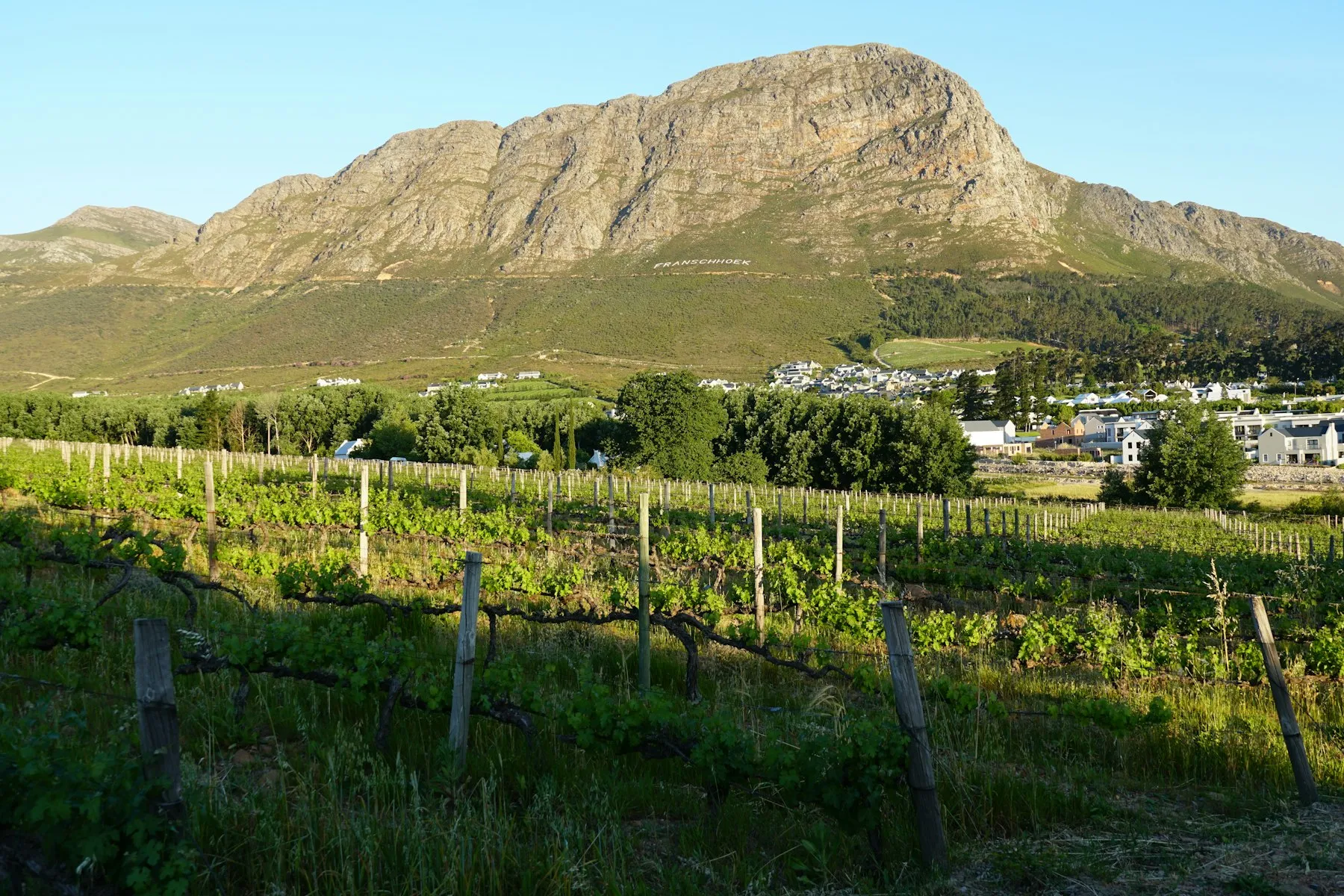
When a north-westerly front pushes moist Atlantic air against the mountain, the air is forced upward. Rising air cools, cooling air cannot hold as much moisture, and the moisture falls as rain. This is orographic lift, and it means the eastern slopes below the mountain, through Constantia and up toward Kirstenbosch, receive considerably more rainfall than the City Bowl or Camps Bay a few kilometres away.
The practical consequences show up everywhere. Gutters here handle more volume. Roofs stay wet longer, so moss and algae grow more readily on shaded slopes. Soil stays saturated for longer stretches through winter. And the black south-easter, a wet variant that brings dense cloud on a south-easterly flow, adds rainfall to these eastern slopes outside the normal winter pattern.
A roof specification that is adequate in Sea Point can be marginal in Constantia, and the difference only shows in a bad winter.
Saturated Ground on a Sloped Site
The thing we are called about most here.
Constantia sits on ground that slopes, and slopes collect water. Rain falling anywhere uphill moves down through the soil until something interrupts it, and a house built into a slope is that interruption. The uphill wall becomes a retaining structure holding back saturated soil, sometimes for months at a stretch through winter.
This produces a very specific and very commonly misdiagnosed pattern: damp appearing at the base of an internal wall from June onward, drying out by summer. It gets treated as rising damp, a chemical DPC gets injected, the plaster gets replaced, and it returns the following winter. Because it was never rising damp. It was lateral water arriving through a buried wall.
The same mechanism affects the cellars and below-ground rooms common on the larger properties here. A wine cellar cut into a slope has hydrostatic pressure against its buried faces every winter, and a cellar that is dry for eight months of the year is not a dry cellar, it is one that has not been tested since September.
The fix is usually drainage rather than coating. Intercepting water uphill of the structure with a properly laid subsoil drain does more than any product applied to the wall.
Trees, Gutters and Everything They Cause
Constantia mature oaks, pines and plane trees are a large part of why people live here, and they are hard on buildings.
Gutters need clearing twice a year, not once. Autumn leaf fall is the obvious load. Pine needles are worse, because they arrive year-round and knit into a mat that water cannot pass through.
Overhanging branches keep roofs permanently shaded and damp, which is ideal for moss and lichen. Moss holds water against tile surfaces through summer as well as winter, and grows into tile joints, lifting edges.
Valleys fill with debris and a blocked valley leaks far faster than a blocked gutter, because the water has nowhere to go except under the tiles.
Overflowing gutters saturate the ground at the base of walls, which on an already-saturated sloped site compounds the damp problem directly.
A large share of what we are called to in Constantia traces back to a gutter, and gutter work is a fraction of the cost of the damp treatment it prevents.
Housing Stock Here
Constantia building stock spans a wide range, and each brings its own failure mode.
Older Cape Dutch and period properties, often with solid walls, no original damp proof course, thick lime-based plaster, and heritage constraints on what can be altered.
Mid-century and later houses with concrete flat roofs, tiled pitched roofs, or a combination on additions built at different times. The junctions between original structure and later additions are a reliable source of leaks.
Large modern homes with complex roof geometry, flat sections, balconies and glazed junctions, all of which add detail points.
Outbuildings, cottages and cellars, frequently older than the main house, frequently with the least maintenance.