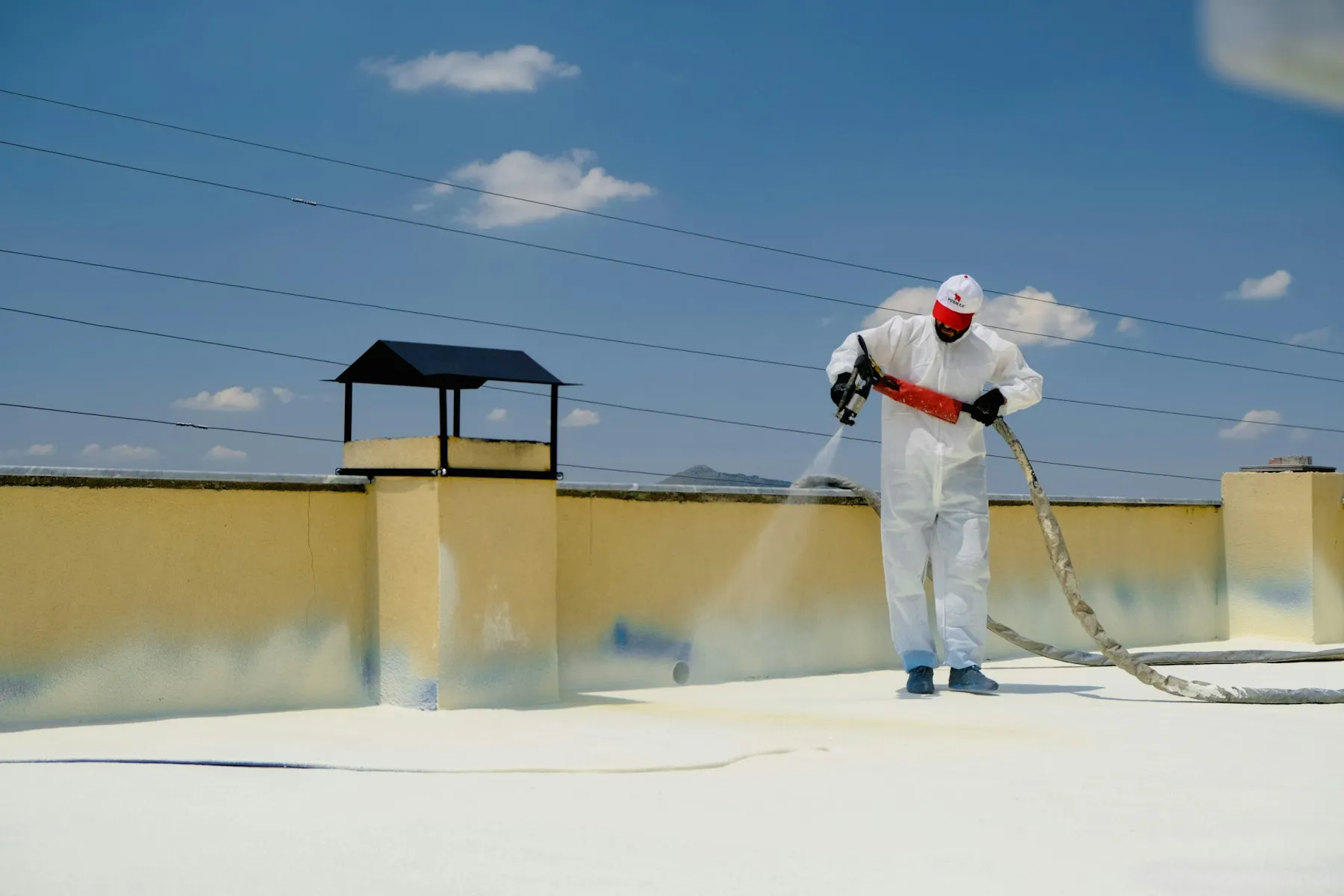
A liquid waterproofing coating being sprayed onto a flat roof

Liquid Rubber Waterproofing Cape Town

Liquid rubber waterproofing in Cape Town has one real advantage over sheet systems, no laps to fail. It also has one real weakness, and that is being applied too thin. Free inspection, two-year written guarantee.

Seamless Is the Whole Argument

Every sheet membrane has joints, and joints are where roofs leak. Liquid rubber has none. It goes down wet, cures into a single continuous film, and runs straight up an upstand and into an outlet without a seam anywhere.

On a simple rectangle that advantage is modest. On a roof with eight vent pipes, an aerial mount, two plant plinths and a stepped parapet, it is decisive. Every one of those is a detail a sheet system has to be cut and welded around, and every one is a potential failure point.

That is the case for liquid rubber, and on the right roof it is a strong one.

Thin Is the Way It Fails

A liquid system is only as good as the film thickness it cures to, and thickness is where the money is. Spreading one coat where the specification calls for two is invisible on the day and obvious in three winters.

Wet film thickness gets measured, not estimated. A gauge in the wet coating is the only honest check. Coverage rate per litre is the number that matters, and stretching it is the most common corner cut in this trade.

Reinforcement at the details. Upstands, outlets, cracks and junctions between materials need a reinforcing fleece or scrim embedded in the coating. Coating alone across a moving crack will split along it.

Preparation is most of the job. The surface must be clean, sound, dry and primed. Coating over dust, chalking paint or laitance produces a film that peels off in sheets.

It cannot bridge a structural crack. A crack that moves needs a joint detail, not more coating.

Where Liquid Rubber Beats Torch-On, and Where It Does Not

Better on: complex roofs with many penetrations, awkward shapes, box gutters, flashings, roofs where an open flame is a fire risk, and roofs where a lightweight system matters.

Worse on: roofs taking regular foot traffic, roofs that will be tiled or covered, and any surface where consistent thickness across a large area is hard to control.

Torch-on is tougher. Liquid rubber is more adaptable. Neither wins in the abstract.

UV, Salt and the Cape Town Coast

Liquid systems sit exposed, which means UV works on them constantly. Cape Town summer sun and the reflected light off the Atlantic are hard on any exposed coating, and a system that chalks or embrittles will craze within a few seasons.

Salt-laden air on the Atlantic Seaboard adds a second problem. Salt crystallising in a surface film accelerates breakdown, so coastal roofs need a system rated for that exposure and a wash-down as part of routine maintenance.

The summer south-easter contributes too. It is dry, so it will not push water in, but wind-carried sand abrades an exposed coating like fine sandpaper, particularly on the West Coast side.

How It Works

  1. 1

    Free site inspection

    Substrate tested for soundness and moisture, penetrations and details counted, coverage specified.

  2. 2

    Written quote before work starts

    Preparation and substrate repair quoted separately from the coating.

  3. 3

    Application

    Surface prepared and primed, reinforcement at details, coats applied to specified thickness and checked wet.

  4. 4

    Guarantee and follow-up

    Two-year written guarantee, plus a check after the first winter.

What Liquid Rubber Waterproofing Costs

Cost tracks litres and preparation more than anything else.

  • Coverage and number of coats.Specification in litres per square metre, not a vague coat count.
  • Substrate condition.Chalking, delaminating or contaminated surfaces need stripping and priming first, quoted separately.
  • Detailing count.Every penetration, upstand and outlet needs reinforcement, and that is labour.
  • Access.Height and lift access change the figure.
  • Existing layers.Whether the old system can be coated over or has to come off.

A quote that does not state coverage rate is not a quote you can compare.

Get a written quote

Why Choose Us

  • We inspect before we quote

    Nobody prices a roof from a photograph or a phone call. We get on the roof or into the roof void, establish what is actually wrong, and quote from that.

  • Preparation is quoted separately

    Substrate repair, falls correction and strip-off appear as their own line items. That is the part that determines whether the work lasts, and the part most quotes hide.

  • We say when repair is the cheaper answer

    Plenty of roofs quoted for replacement need a day of repairs. We tell you which yours is, including when it means a smaller invoice for us.

  • Two-year written guarantee, in writing

    Minimum two years on our workmanship, with the scope set out on the quote before you sign. We check the work again after the first winter.

Liquid Rubber Waterproofing FAQs

How much does liquid rubber waterproofing cost in Cape Town?

It is driven by coverage rate, number of coats, preparation and how many details need reinforcing. We specify litres per square metre on the quote so you can compare it against anyone else quote.

How long does liquid rubber last?

Applied to the correct thickness on a properly prepared substrate, well over a decade. Applied thin, it can craze within three or four seasons. Thickness is the variable.

Is liquid rubber better than torch-on?

On a complex roof with many penetrations, usually yes. On a roof taking foot traffic or being tiled over, usually no. The roof decides.

Can liquid rubber go over my existing waterproofing?

Often, if the existing layer is sound, well bonded and compatible. Chalking, blistering or delaminating layers come off first. We test adhesion before committing.

Will it bridge cracks in my roof?

Hairline cracks, yes, with reinforcement embedded. A structural crack that moves needs a proper joint detail. Coating alone over a moving crack splits along the crack.

Can it be applied in winter?

It needs a dry substrate and dry weather through the curing period, which a Cape Town winter rarely provides. March and April are better.

Does it work on a roof that ponds water?

Only if the system is rated for standing water, and even then ponding should be corrected. Standing water is a falls problem, and coating over it does not fix it.

How do I know it was applied thick enough?

Wet film thickness gauge readings during application, and a quote that states coverage in litres per square metre. Ask for both. It is the easiest place in this trade to cut a corner.

Does salt air affect liquid rubber?

Yes. Salt crystallising in the surface accelerates breakdown, so coastal roofs need a system rated for that exposure and a periodic wash-down.

Free inspection, written quote, no obligation

We come out, establish what is actually wrong, and put it in writing with preparation costed separately from the waterproofing.

  • We inspect before we quote, on the roof or in the roof void
  • Preparation and substrate work itemised separately
  • Two-year written guarantee
  • A check after the first winter
068 890 3548

Request a quote

Tell us what is happening and we will arrange the inspection.

No charge for the inspection, and no obligation.

Call for a free inspection